

Qatar’s Carbon Bombs
We all love football and most of us are watching the FIFA World Cup taking place in Qatar. But what about the planet?
We all love football and most of us have been watching the FIFA World Cup taking place in Qatar. But what about the planet? FIFA acknowledges that the Earth’s climate is changing due to human activity. But, as pointed out by Wired, FIFA’s efforts to reduce the huge carbon footprint of 3.6 million tons of carbon dioxide emissions, have failed according to a number of experts.
However this high-carbon event is dwarfed by the emissions that will be released if the country fully exploits its oil and gas fields. It is estimated that these giant ‘Carbon bombs’ will add 50 billion metric tons of carbon dioxide to the atmosphere. To raise some awareness of the Carbon Bombs issue we thought it would be useful to show the actual volume of that gas, as giant footballs. Our belief is that we can both enjoy the spectacle of national football AND strive to create a green, renewably powered planet for our children.


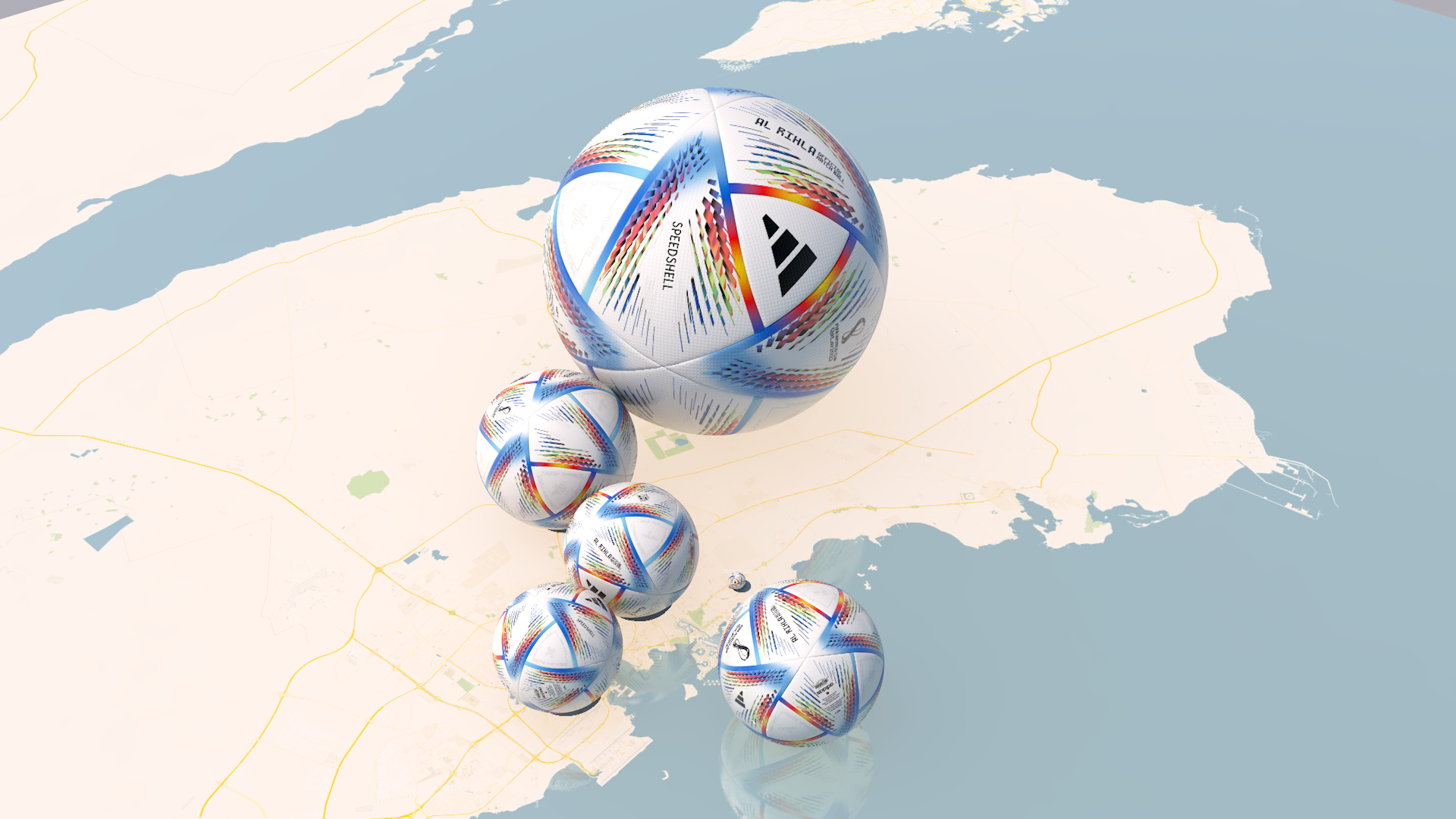


More information on this from BankTrack here.
High resolution images are available in this Flickr album: https://flic.kr/s/aHBqjAikp6
Notes
Fossil gas is only required in the short term as a transition energy source as the world switches to properly insulated buildings and renewables like wind and solar backed up by large-scale battery storage.
A Carbon Bomb is a coal, oil or gas project that can cause over a gigatonne of CO₂ emissions during its lifetime. That's a billion tonnes – more than twice the UK's annual emissions from a single project.
FIFA estimate of CO₂ emissions: qatar2022.qa/sites/default/files/2022-08/greenhouse-gas-accounting-report-en.pdf
Potential emissions estimates: Kühne et al, 2022 “Carbon Bombs” - Mapping key fossil fuel projects doi.org/10.1016/j.enpol.2022.112950
Analysis of 1.5 °C compatible scenarios from the IPCC Special Report on 1.5 °C shows unabated use of natural gas in primary energy supply globally should already have peaked and be declining globally, and that it needs to drop by more than 30% below 2020 levels by 2030, and 65% below 2020 levels by 2040 (https://climateanalytics.org/media/gas_is_new_coal_nov_2021.pdf
Data is from Bank Track
One-percenters take to the air
Flying accounts for about two percent of the worlds greenhouse gas emissions, but the impact of some passengers is greater than others. Just one percent of the world’s population account for half of all aviation emissions. In a week when the great and good are flying into the World Economic Forum at Davos by private jet, we have decided to take stock.
Flying accounts for about two percent of the worlds greenhouse gas emissions, but some passengers’ impact is far greater than others. In a week when the great and good are flying into the World Economic Forum at Davos we have decided to take stock.

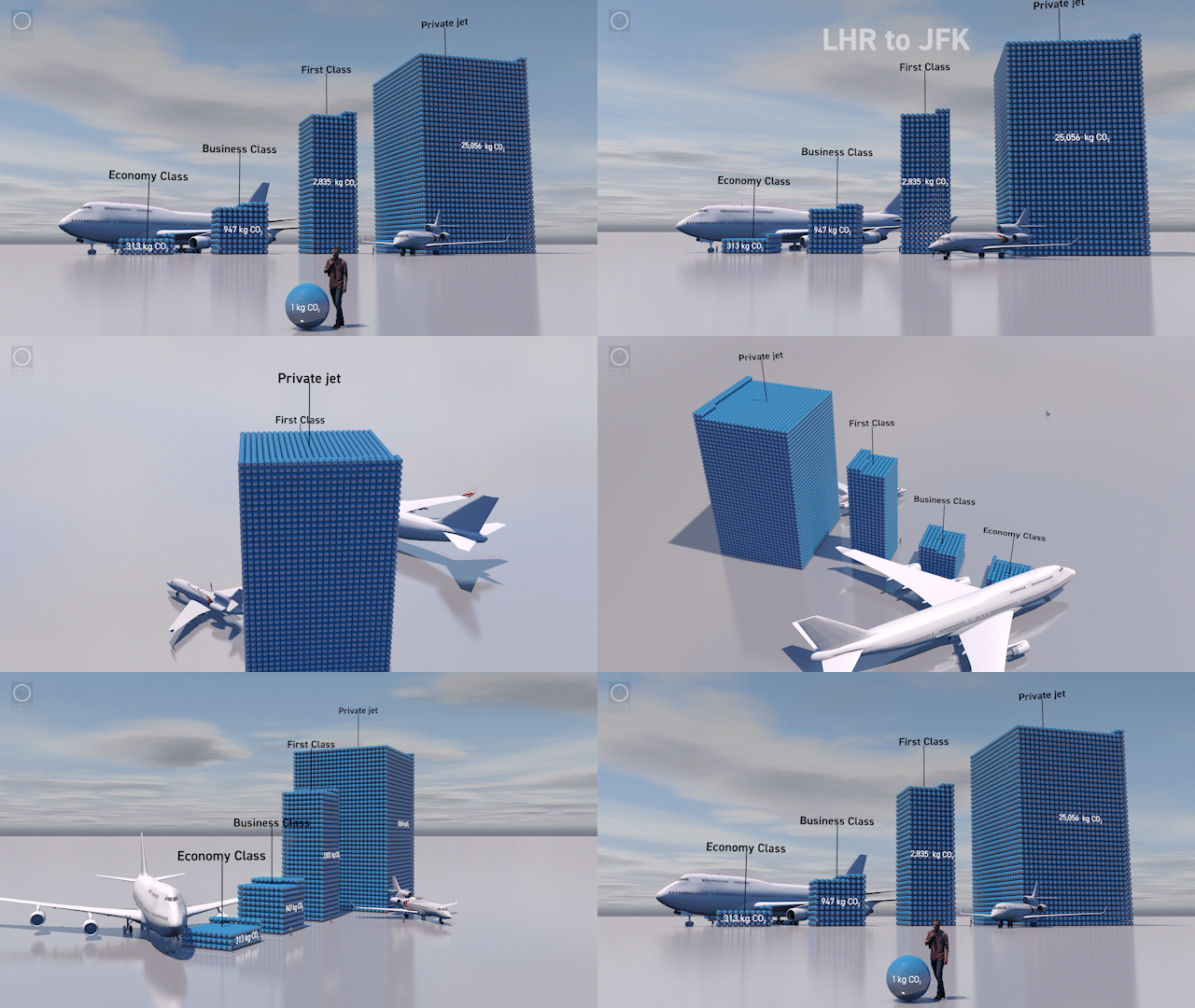
Each sphere is a kilogram of carbon dioxide gas at 15 °C and atmospheric pressure.
A jumbo jet flight from London to New York adds about 200 metric tons of carbon dioxide to the atmosphere. Divided between 349 passengers (84% occupancy) that’s 572 kg each. But Business Class passengers take up more space than Economy Class, and First Class passengers even more space.

Emissions from travelling from London Heathrow Airport to John F Kennedy Airport (New York City)
So a transatlantic passenger in Economy Class adds greenhouse gas to the atmosphere equivalent to 4 weeks of emissions from a typical European household. But each First Class passengers contributes more than 38 weeks emissions.
Many invited to Davos, though, choose to travel by private jet. This is far less efficient than a scheduled flight. A private jet uses as much fuel as 9 First Class passengers, 26 Business Class passengers, or 80 Economy Class passengers. Crossing the Atlantic in a private jet adds about 25 metric tons of carbon dioxide to the atmosphere. That’s 6 years of emissions from an average European household (each way).
This is why, overall, just one percent of the world’s population account for half of all emissions from aviation. Our Prime Minister Boris Johnson is likely one of them. He famously left the COP 26 meeting in Glasgow by private jet because some old colleagues of his were having a knees-up in London.
Notes
1% of the world’s population is responsible for 50% of aviation emissions: Stefan Gössling, Andreas Humpe, ‘The global scale, distribution and growth of aviation: Implications for climate change’, Global Environmental Change, Volume 65, 2020, https://doi.org/10.1016/j.gloenvcha.2020.102194
(Hat tip: Transport & Environment, 2021. Private jets: can the super rich supercharge zero-emission aviation?)
Emissions for a Boeing 747 were calculated with reference to Boeing documents. The particular model was the 747-400ER with GE engines. Typical mission rules were assumed (Fuel burn / seat 6,000 nmi = 304.5 kg).
The distribution of the 747’s emissions by passenger class was calculated with reference to a World Bank Report: Heinrich Bofinger & Jon Strand 2013, Calculating the Carbon Footprint from Different Classes of Air Travel , Policy Research Working Paper #6471
The private jet calculation assumes a Falcon 8X. Emissions were determined with reference to a commercial off-setting company: https://www.paramountbusinessjets.com/private-jet-carbon-offset-system/
The density of carbon dioxide gas at 15 °C and 1 atm is 8.714 kg.m⁻³. 1 kg of CO₂ gas would fill a sphere 1,006.8 mm in diameter.